Saturday, February 22nd, found us waking up in Aswan. This was going to be a great day. There are 'cataracts' at Aswan. Actually, there are several places along the Nile River with cataracts. A cataract in this instance is a lot of rocks that form rapids which larger vessels cannot traverse. However, cataracts are a wonderful place for bird watchers because many varieties of birds live there. In order for us to see the cataracts we would need to be in a smaller boat.
After breakfast we gathered in the lobby of our cruise ship. When there are many cruise ships in a harbor they park they two to four abreast. The doors to our cruise ship were opened and we walked through the lobby of the ship next to us to get to our little ship which was parked by the ship next to us. Never have I done that before.
Our little ship was the bottom part of a boat with poles holding a roof. The roof was sturdy enough for us to walk and sit on but we were asked to ride below. It kept us out of the sun and life is a little warmer in Aswan that in Cairo.
Our destination would be where we would start our camel rides. I will share a few pictures of the cataracts going to meet our camels and returning.
This tower on top of a hill is a lot like the towers in the Lord of Rings movie in which they light a fire and someone on a mountain top a little further down sees it and lights their fire and that process continues to spread the word about a possible danger or other event. These little towers were placed all along the Nile River so that in 30 minutes time a message could be sent from Aswan to Cairo. That is pretty quick for a distance of about 550 miles by car.
The thing on a pole is a light so the cataracts can be lit at night.
The picture below is Elephantine Island. There are ruins of a Temple to Khnum and another to his female counterpart, Satet, as well as other ruins. Elephantine Island also has another of the three Nileometers along the Nile River. We did not get off our boat to tour this Island.
This was our destination. The northern portion of Nubia. Here we would learn to get on a camel and then ride it for 20 minutes through the desert to the little Nubian village pictures below with all the blue painted roofs and homes.
These are some of the camels our tour group would ride. In the front are two saddles for the camels. To get on the camel you would place one hand on the horn in front and one hand on the horn in back. You would sit as close to the front horn as you could. Then the camel handler would have the camel stand while you leaned back as far as you could and stayed leaning until the camel was standing. Then you would place both hands on the front horn and ride sitting straight up staying close to the front horn.

I took this picture of my camel while I was riding on it. I was not the first person in our group to get on a camel but somehow I was the first person they led onto the trail. I asked the handler if my camel had a name. He said, "Jamba Jamba." So here you have Jamba Jamba plodding across the desert to a Nubian village with me on his back. I just have to say this was soooooo much fun!!! I would do that again in a heart beat. You sit so high you feel you are on top of the world. I thought part of the fun of riding on a motorcycle was being tall enough to see over a lot of things. Multiply that times at least 10 and you get the thrill of riding this huge, lumbering beast. Time slows down and the world is just simply gorgeous traveling this way. By the way, Claude just named his camel Wildfire.


This is the home in the Nubian village we would visit. Mr. Rabee is 80 years old and Nubian. His home is one of the oldest in the village. The entire family resides here, his parents, wife and children, their wives and children. He keeps crocodiles in a pin constructed in his living room. The picture below his home shows paintings on his wall that depict his life. This one tells that he made the Hajj to Mecca and, if you look to the left, you see a camel which says he made his Hajj on a camel. The third picture is also a portion of his living room. The wall paintings tell that he was a fisherman and owned a boat.


We were given 'hibiscus tea' to drink. We would be offered this beverage 3 times during our stay in Egypt. I read about hibiscus tea in several travel guides before we went on this trip and was hoping we would get to taste it. It is made from dried hibiscus blossoms. You simply boil water and place the dried hibiscus in the water and let is brew for a few minutes. Then remove the hibiscus and enjoy the tea hot or cold. I would recommend a little sugar as this is a very bland tea. But it is a real Egyptian treat and I was very happy we were served it.
Then Mr. Rabee brought out the crocodile. Claude got to hold it and I got the kiss it!!
Soon it was time to say goodbye to this lovely Nubian village and head back through the cataracts to our cruise ship for dinner. This was a great experience and I would highly recommend it to anyone touring Egypt. In the back of this picture is the Aswan High Dam.
I saved this picture of the cataract tour because it happened just before we got back to our cruise ship. These two little guys got to our tour boat on something like a surf board. They grabbed on to the side of our tour boat and let it pull them along on their surf board all the while singing at the top of their lungs something in Arabic. It was great fun to hear them and their singing and laughter.
We ate a quick lunch so we could meet our tour bus for the remainder of the day. Our next destination was Abu Simbel but it was a 3 hour bus ride there and 3 hours back. We had a security officer on our tour bus again to help us pass security so we could get on the highway. We would drive through a bit of Aswan, then over the High Dam and through the Nubian desert going around Lake Nasser to Abu Simbel. The fact we drove 3 hours around Lake Nasser to get to Abu Simbel gives one a little idea of how huge this lake is.
This picture is of the Broken Obelisk. You can see the flat stone in the middle of the picture. An obelisk had to be made of one stone with no breaks. It was not made in pieces stacked on top of each other. This obelisk cracked when they were trying to cut it out of the ground and was just left where it lays. It has been a great place of archaeologists to try learn how they carved these huge obelisks. It was located across the highway from the security station we went through before crossing the Aswan High Dam and heading into the Nubian desert.
These are a few pictures of Aswan. They are top to bottom of this section: a Muslim cemetery, a soccer stadium that looks in great disrepair but is actually used, a street vendor using a cart that would have been drawn by a donkey, and motorcycle trucks (I found these little things fascinating).
Then we crossed the Aswan High Dam with Philae Island off to the side. The Temple to Isis was on Philae Island.
Soon we were in the Nubian Desert. The first picture looks like there is water in the background. That is a mirage. NO water. The third picture is a home in the desert. I am ever so grateful for my home on a hill in Sadieville. The channel of water in the next picture marks where the Tropic of Cancer goes through Egypt. The next picture is just a little mountain that happens to look like a pyramid. We saw many of these in the Nubian Desert. The final picture just reminds me of what the surface of the moon might look like.
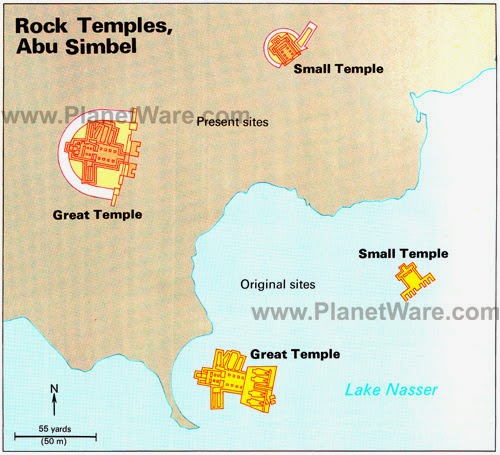
Now, our goal, Abu Simbel. I will start with two diagrams I took off the Internet.
The first shows the location of Abu Simbel originally and where in stands today with regard to Lake Nasser. When the Aswan High Dam was built Lake Nasser was created behind it. As Lake Nasser filled with water it would have covered many of Egypt's amazing antiquities. Abu Simbel would have been one of these. The world community donated money so this amazing temple could be taken down and rebuilt on higher ground so it would not flood or be covered with Lake Nasser.
The temples of Abu Simbel were Nubian style temples. Instead of building their temples out in the open like all the temples we had been through, the Nubian temples were carved into the mountain. There are actually two temples at Abu Simbel. The first and largest (Great Temple) is to Ramesses II. The second and smaller (Small Temple) was built to Nefertari, Ramesses wife.
This second diagram shows how the interior of these two temples would look. We were not allowed to photograph the interior of these temples. But this diagram gives a great feel to the interior of the temples.
Here is what the temples look like today. The Temple to Ramesses II is on the left. The Temple to Nefertari, his wife, is on the right. Keep in mind these were cut into huge pieces and moved to this higher location. They were reassembled and then a mountain built over them so they look like they did when they were on lower ground.

This picture is Ramesses II Temple. At the very back inside the mountain is the sanctuary of the temple. There are four statues in a row of their gods. Ramesses II is one of these four statues. One day each year the sun would come through the front door and shine all the way through the temple to the four statues of the gods. When they moved these temples it was thought they had them aligned exactly as they had been built to have this sun event, but they were one day off. We arrived the day after the event. The day of the event this area was filled with visitors to witness the sun shine on these states of gods. The day we arrived the huge parking lot had one bus on it and that was our bus.
This picture is Claude in front of the Temple to Nefertari.
These are pictures of Lake Nasser around Abu Simbel.
After our visit we all boarded our bus for the three hour trip back to our cruise ship. One more night on the Radamis I. Then we would head back to Cairo.